I build automation systems that clean up operations and remove manual work.
Workflow automation, AI-powered operations, CRM architecture, and business systems for teams that have outgrown spreadsheets and Zapier. Self-taught, hands-on, and obsessed with the unsexy plumbing that actually moves the needle.
Marketing Operations & Automation Specialist · n8n · GoHighLevel · Airtable · Vapi · Available for full-time remote roles.
A few of the systems I've designed and shipped.
Async cold email and qualification — without booking a single call
A 33-workflow production system spanning end-to-end outbound infrastructure across 96+ sending mailboxes and multiple secondary domains. Domain provisioning, DNS authentication (SPF/DKIM/DMARC), Instantly warmup management, and reply routing into GoHighLevel.
The differentiator: an AI decision engine that handled all reply triage — no sales calls, no booking links. The agent qualified inbound interest in real time, routed hot leads directly to a contract and checkout flow, and pushed tire-kickers into a long-form nurture sequence.
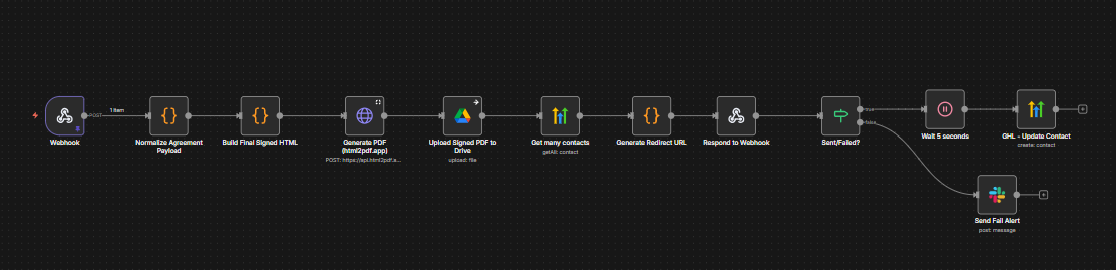
Signed contracts are generated as PDFs and stored automatically, with the client able to download their copy immediately and receive an emailed copy as well. A Slack alert fires on both outcomes — a signed contract (sale) or a failed/incomplete signature (follow-up needed) — so a human always knows the moment attention is required, without babysitting the pipeline.
Result: zero human hours spent on sales calls or manual reply sorting — every inbound reply across 96+ mailboxes was triaged, qualified, and routed automatically, with signed contracts generated and sent without a single manual document handoff.
The contract side was equally hands-off: webhook intake, dynamic HTML-to-PDF contract generation via html2pdf.app, signature capture, and CRM record creation — eliminating manual contract handling entirely.


Outbound voice AI agent for real estate broker outreach
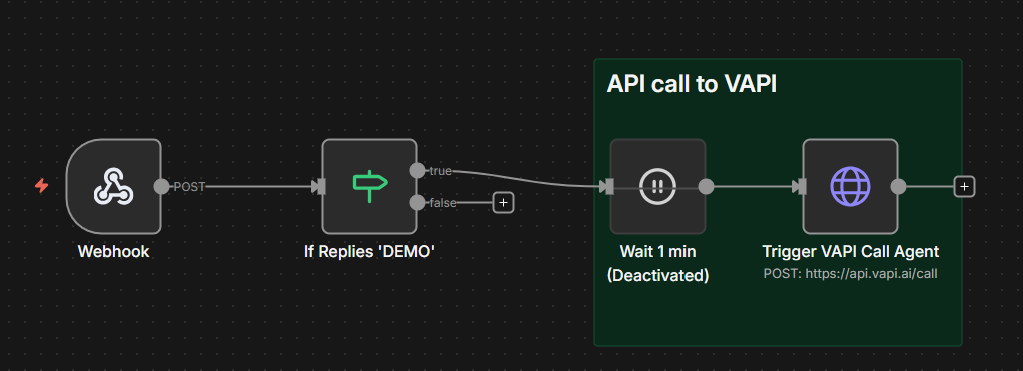
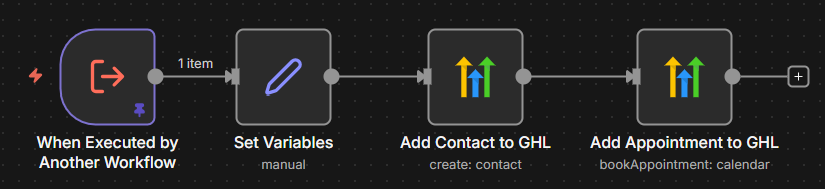
Built and deployed an AI voice agent on Vapi orchestrated through n8n and integrated with GoHighLevel — well before voice AI hit mainstream adoption. The agent qualified inbound leads, handled callback scheduling, and pushed structured call data into the CRM. Required navigating a complex Vapi · n8n · GHL integration including webhook routing, real-time call event handling, and call disposition logic.
Result: inbound leads qualified and appointments booked directly into GHL without a human ever picking up the phone.
Automated SMS reactivation for dormant CRM contacts
Designed a multi-stage re-engagement sequence in GoHighLevel for businesses sitting on thousands of unworked leads. Conditional branching on response, custom field updates to track engagement state, automatic pipeline stage progression, and reply routing to a sales rep. Surfaces warm conversations from previously dead lists without manual outreach.
Result: dormant contacts revived into active conversations without a rep manually working a single dead list.
Source → enrich → verify → segment → outbound
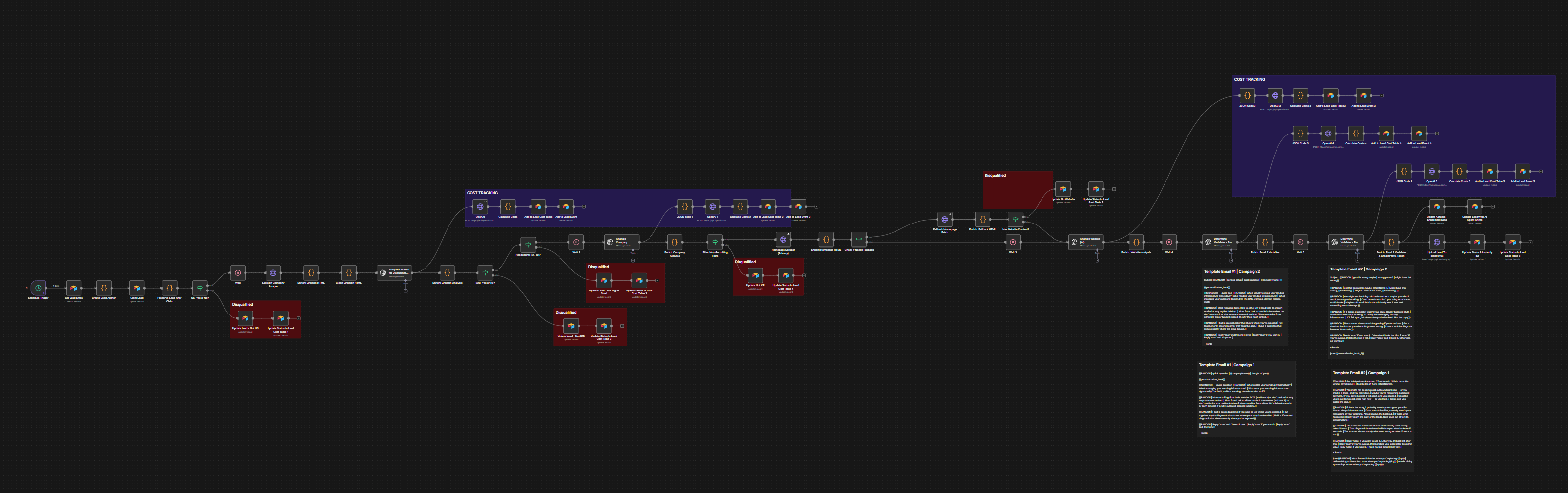
Built a multi-stage n8n workflow that ingests business data from multiple sources — scraped via Apify and sourced from purchased lead lists — normalizes and deduplicates records into Airtable, validates email deliverability through a self-hosted Reacher instance (replacing paid MillionVerifier API calls), applies segmentation logic for industry and geography, then pushes qualified contacts directly into Instantly campaigns. Cost-per-lead reporting and campaign attribution feed back into Airtable for ongoing optimization.
Result: verification runs on a dedicated $10/month host — a flat cost regardless of volume, versus per-credit verification APIs that scale up with every email checked.
Custom web tools on Supabase for tracking work, income, and projects
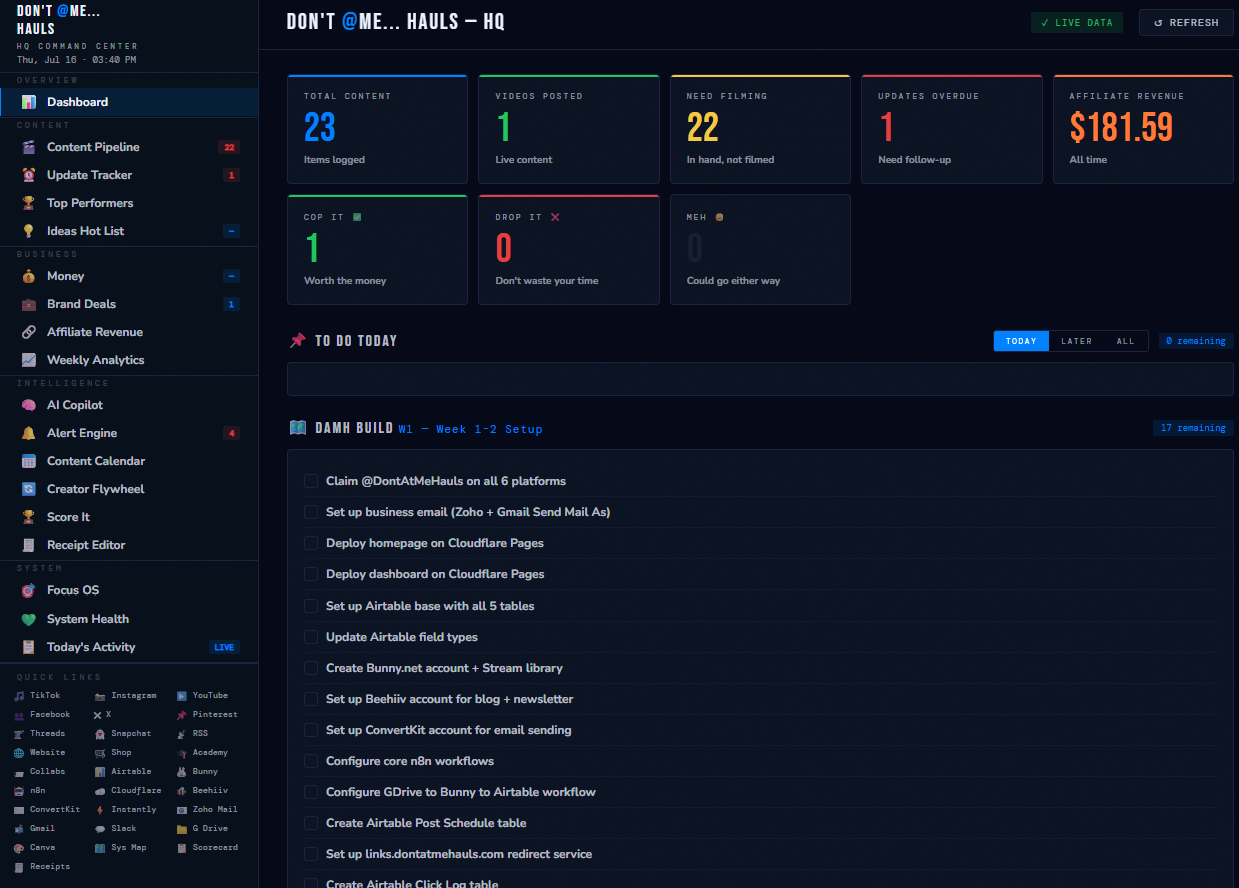
When off-the-shelf tools didn't fit, I built my own. DAMH HQ is a full command center for my Don't@Me Hauls content brand — content pipeline tracking, affiliate revenue, an alert engine, and an AI copilot, all synced live to Airtable. Focus OS tracks work sessions, pay rates, and per-platform earnings with bidirectional Airtable sync. Budget OS handles personal finance with income, expenses, goals, and AI-powered insights. Shotcaller is an Airtable-backed creative production tool. All single-file HTML apps with Supabase (Postgres + auth) backends.
Result: one live dashboard replacing several disconnected spreadsheets and manual trackers, with data flowing in from Airtable in real time instead of being updated by hand.
Designed, deployed, secured, and maintained a production self-hosted n8n environment
Self-hosted n8n via Docker for full control over workflows, credentials, and execution environment. Manages instance configuration, environment variables, container resets, and version updates from terminal. Avoids the per-execution costs and rate limits of n8n Cloud while keeping workflow data in-house.
Result: unlimited workflow executions on infrastructure I control, debugged from a multi-day production incident (Traefik crash-looping, a port conflict with the host's native nginx) to stable 7+ day uptime.


Tools I work in every week.
A few working principles.
Map before you build
Every workflow starts as a diagram, not a node. Trigger, data shape, branches, error states. Building without a map produces fragile spaghetti.
Plan for failure
APIs go down. Webhooks misfire. Data arrives malformed. Every workflow has explicit error branches, retries, and alerts — not silent failures.
Idempotent by default
Workflows should be safe to run twice. Check for existing records before creating, and design data models that survive re-runs without duplication.
Document like you'll forget
Sticky notes inside n8n, plus an external doc explaining business logic, dependencies, and credentials. Future-me always thanks past-me.
How I got here.
I spent fifteen years in hospitality before I ever touched a webhook. That background turned out to matter more than I expected — the operators who run good restaurants think in systems, edge cases, and recovery procedures, which is exactly what good automation requires.
I started building automations in early 2024 because I needed them for my own work — lead generation, contract handling, follow-up sequences. The deeper I went, the clearer it became that this was the work I actually wanted to do full-time. The building itself, not the business around it.
Growth Guerillas LLC is the entity I've been building under for the last two years. It's been the testing ground for everything on this site: real systems, real campaigns, real data. I'm not a YouTube tutorial graduate — I run production workflows daily and debug them when they break at 11 PM.
Every system on this site — I owned it end to end: requirements, architecture, implementation, deployment, and the maintenance and debugging after launch. Not just assembling nodes — deciding what should exist, then keeping it running.
Right now I'm looking for full-time operations or automation roles at companies that take their systems seriously. If that's you, the fastest way to know if there's a fit is to talk.
You've seen the systems. Now meet the human.
Background, work style, and how I think about building. The shorter, more personal version — useful before an interview.
Meet Ronda Simmons →